About    Work     R & D    Journal

May 5, 2007

Tremor

Recent Exhibition
April - August 2007

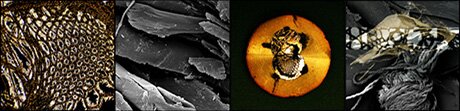
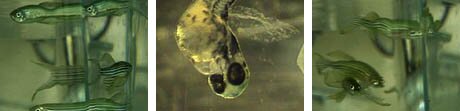
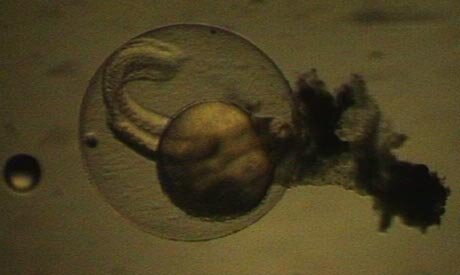
Single screen video projection and sound work with aquariums of live zebrafish based on themes drawn from developmental biology and genetics. Commissioned by Emilie Gomart, guest curator for the Centraal Museum, Utrecht as part of Genesis (Life at the end of the information age), an international exhibition featuring work from artists and scientists and describing parallels between art, the life sciences, computer technology and genetics and presenting key historical models of life systems such as the Crick and Watson DNA model, early computer films, cybernetic art, genetic artefacts and live organisms.

Untitled-5.jpg

genesisspawn1.jpg

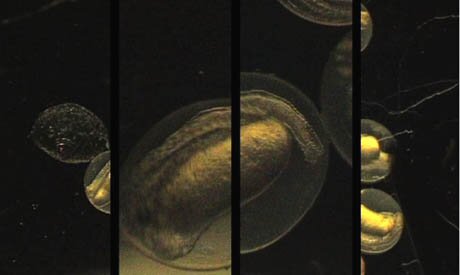
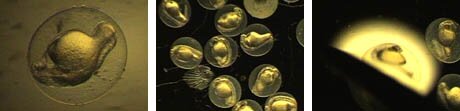
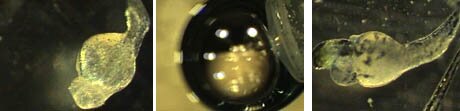
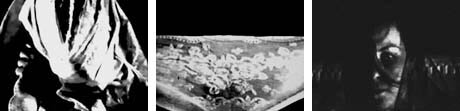
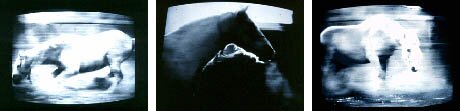
Still from video installation, Tremor, Genesis 2007

spawn1.jpg

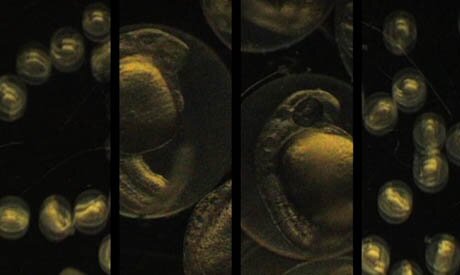
Still from video installation, Tremor, Genesis 2007

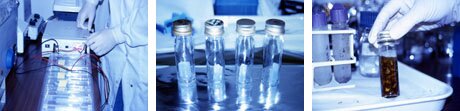
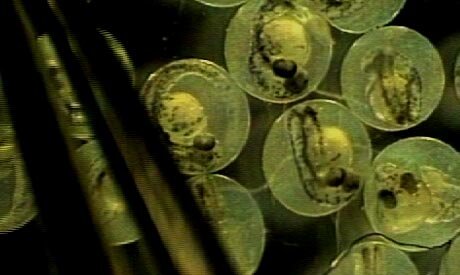
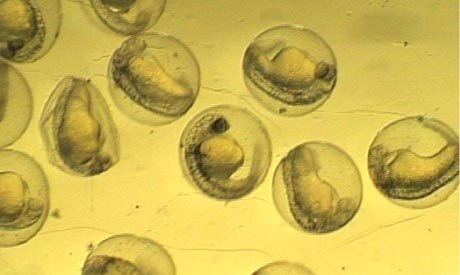
Zebrafish are part of a pantheon of model organisms deliberately bred to study vertabrate development. The fish are small and breed quickly and inexpensive to maintain in large numbers and they are used to search for mutations randomly and then selectively bred. Several genes that control the expression of the human body plan have nucleotide sequences found in a common pattern in zebrafish. These patterns are exposed in the zebrafish genome using Mendelian forward genetics.

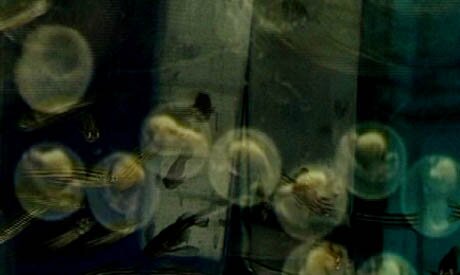
Microscopic evaluations capture the essence of the life force as movement, but paradoxically, making and umaking the gene requires a pathological trespass into the mystery it seeks to reveal. In the microscopic study of fetal growth in living mutations, physical contact and looking create tremors and palpitations that are tactile and reactive and invariably fatal. Visual distortions, physical vibrations, reflections, shadows, scratches, detritus and microbial parasites randomly appear. In Tremor, the difficult co-ordination of the eye and hand, the limitations of a fixed viewpoint and narrow field of view, the optical ambiguities, crude movements, anticipated touch and sensory detail are used to engage the viewer in a visceral and psychological reading of a mediated life form.

genesisspawn2.jpg

Still from video installation, Tremor, Genesis 2007

Untitled-3.jpg

Untitled-2.jpg

genesisshelf4.jpg

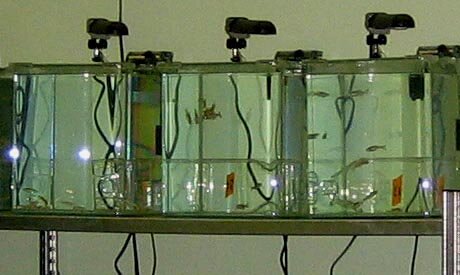
Photo, Aquariums of mutant zebrafish from installation, Tremor, Genesis 2007

Tremor was made with the scientific facilities and support in the Netherlands and the UK. Video microscopy facilities and collaboration were generously provided by Jonathan Clarke and David Becker at the Centre for Cell and Molecular Dynamics, University College, London and Carole Wilson, manager of UCL Zebrafish Facility. Zebrafish were donated by Bas Defize and Dr. S. Schulte-Merker from the Hubrecht Laboratory. Audio design made in collaboration with David Strang.


September 30, 2006

DNA.CORN

Multi projection screen video and surround sound installation with table top dioramas and multiple sculptural elements for the Lab Gallery Space, San Francisco, USA. Commissioned for The Gateway Project, an international collaboration between artists and scientists.

triolab2.jpg

triolb1.jpg

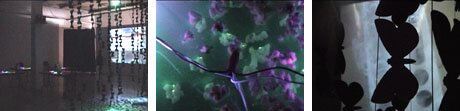
Photos from the gallery exhibition, DNA.CORN at the Lab, San Francisco

Butterfly Chromosomes
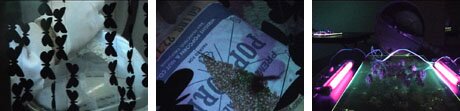
DNA.CORN is a furnace of infinite randomness based on the sounds of popcorn, video projections, ultra-violet dioramas and mock chromosomes in the shape of black butterflies. DNA.CORN utilises the sound and image of popcorn as an anthropological and biological microsystem. A darkly lit ambient space with table top dioramas is used to produce an emotionally arresting scene. Several large video projections and a thousand black silhouetted butterflies inhabit the space accompanied by loud, violently stochastic sounds of popping corn. Sound design in collaboration with digital composer, Carl Stone.

View the DNA.CORN Gallery

Residency
The project was produced as a result of a ten week artist's residency at the Headlands Center for the Arts in Marin County and extended the work, The Imagination of Matter presented at NOISE in Cambridge.

The work was made in collaboration with the Lab and was supported by The British Council and NEA. The Gateway Project was curated by Laura Brun.

Presentation and Publications

Subtle Technologies Conference, University of Toronto, Canada.

Information Arts: Intersections of Art, Science and Technology by Stephen Wilson


August 29, 2006

The Imagination of Matter

Video and sound installation for NOISE at the Kettles Yard Gallery Cambridge.

Installation based on plant biology and DNA made as part of an series of exhibitions put together by the artist Adam Lowe and Simon Schaffer, Professor in History and Philosophy of Science at the University of Cambridge, concerned with universal language, information and transformation as part of an arts and science series presented at Kettles Yard Gallery in Cambridge UK and the Whipple Museum of the History of Science and venues in London as part of NOISE.

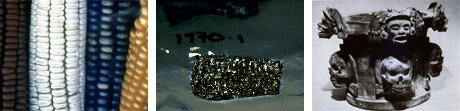
The Imagination of Matter explores the maize genome and draws together the themes of ancient Mayan mythology, archaeology and molecular genetics. The archaeological maize genome is examined in the context of scientific consciousness studies that suggest that matter at an atomic level, carries more complex information at the level of DNA.
trimaize1.jpg

triplem2.jpg

trimaize2.jpg

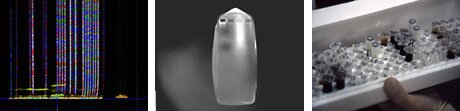
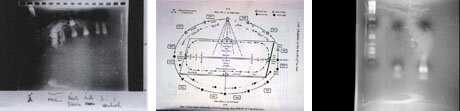
Photos from the scientific and visual research process, The Imagination of Matter exhibition, Kettles Yard.

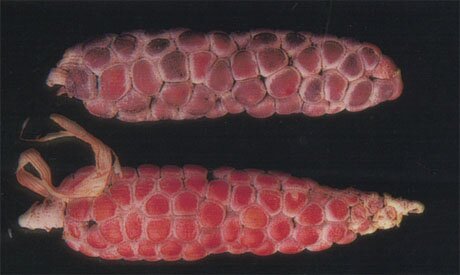
The cultivation and hybridisation of ancient maize was the basis of a cultural technology linking ancient cosmology, calendrical science and social interactions. Standing behind the planting, harvesting and storing of maize was a highly sophisticated understanding and ordering of the world. The Maize plant is an ancestor of wild Teosinte grass and was domesticated in western Mexico at around 8000 years ago. There is a continuity in maize iconography from past to present as evidenced in GM maize technology. Early Mayan cultivators connected the dynamic complexity of the world to the evolution and diversity of maize types.

To a gene scientist their experimental subject of choice is something like a simple string of beads strung together in a necklace of causal effects. Using enzymes, viruses and invasive bacteria geneticists snip or bind a gene from the DNA, copy it, reverse it so that it cancels out its own instructions and then put it back to where it was. Although this process requires an intuitive sensitivity and dexterity, DNA is more highly charged, fluid and dynamic than a simple alphabet. DNA is pervasive, highly evolved and illusive and encompasses four billion years of biological evolution. This relational order stretches from the humble torn to pieces drosophilia in a genetics lab to the perfect symmetry of an embryonic seed kernel raised from 8000 years of dormancy.
large2.jpg

Photo of wild primitive maize cobs

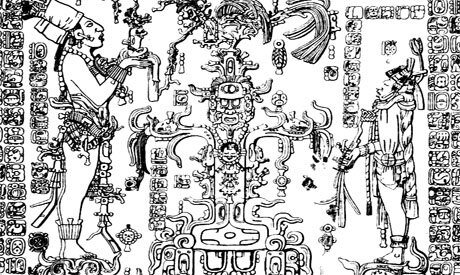
In the metaphorical domain, maize was a link between the mundane and the magical. A symbolic host of a ressurectable and self-producing body. The hardened cob was likened to bone, shell, the phallus, rain and semen and maize was understood as a complete living and transforming organism. The spiralling and twisting language of DNA and mythologised narratives concerning it's genesis in the Popol Vuh provide links with the complexity of the world being mapped by molecular genetics.

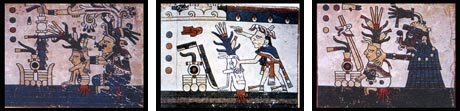
Maize was symbolically conceived as linking soil to sky. It was a technological expression of a relational order that extended from the underworld to the heavens. It was as central to Mayan cosmology as the ceremonial cities were. As in many ancient cultures, the relation between religion and astronomy was very close and maize had an astro-biological parallels. The religious symbolism of maize was integrated into a form of natural magic and it was considered to be a dramatised vehicle for communication between the natural and supernatural realms.

The human characteristics of maize in ancient Mayan iconography and the physical evidence of maize in ethnography as an alive, conscious and responsive entity make maize symbolically potent. Early cultivators connected the dynamic complexity of the world to maize hybridisation much in the same way as modern day biotechnologists connect and alter species boundaries in genomic research.

Maya cosmology scored and made visible process charting systems of life in systems of images. In their art they mathematically projected dates and events forward into our own time and beyond to commemorate future rituals in anticipation that they would be remembered. They also invented the concept of zero and placed numbers to correlate with astronomical events that happened millions of years in a fictional past. This work is in invocation of the first moment of creation and mediated through traditional knowledge, shamanic technology, artistic invention and scientific inquiry.

This human reflection on Maize enabled symbolic and linguistic classifications to take shape. By observing the shapes and features of the developmental processes of Maize collective representations in the form of mythical narratives took shape.

In the spiral/vortex of the female maize ear. The paired symmetries of proteins and water were displayed like a digital abacus and thousands of varieties of maize, cross pollinated by the moist breath of wind, formed a complete colour coded information system. Maize was considered to be kin, a gift from the gods and each colour, yellow, red, blue black was part of a directional scheme.

The survival and growing of Maize depends upon servicing this odd human creation using technological tools. The fact that cultivation fertilisation and harvesting are achieved by specialised equipment and technology reinforces the theme suggests Maize has symbolically always belonged to humans rather than nature.

I approached the scientific process in non-reductive ways that suggested the structural resonances to the origins of maize in pre-history and used archeological DNA analysis to resurrect the cultural message of the original Mayan cultivators.
large4.jpg


largexx.jpg


I argue that a simple theory of consciousness can be advanced by accepting that the mental is a property of matter. I argue that we can reconstruct how consciousness developed (evolved) from unconscious organisms. I argue that, rather than studying the evolution of the brain or the evolution of language or the evolution of tools, we need to study the "co-evolution" of memes, language, tools, emotions, brains. They influenced each other. Mind "is" the result of that co-evolution.

Piero Scaruffi
Towards a Science of Consciousness 2001

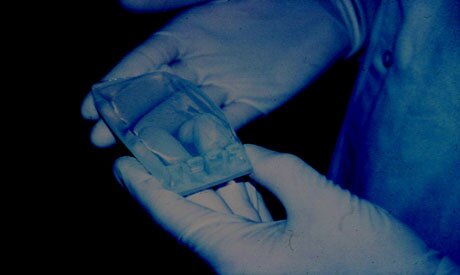
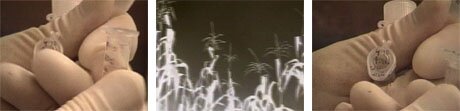
To carry out the work I went to meet Professor Martin Jones at the Archaeology Department, Cambridge University with a proposal based on the destructive analysis of a prehistoric maize plant sample and my key philosophical themes. At my request he was able to arrange for the DNA analysis of an ancient sample of maize in the museum collection from El Reigo caves in Puebla Mexico to be carried out at The Archaeobotany facility at the Biomolecular Sciences department at the University of Manchester. I delivered the dessicated sample to a visiting researcher from Brazil Fabio de Oliveira, a microbiologist making genetic comparisons between ancient and modern maize in the Amazon regions of South America. It was arranged through his supervisor Terry Brown, for me to observe and video document his work on the Cambirdge museum maize sample. I spent a week in Manchester following and recording each step of the DNA isolation process.

In the world of scientific research, we are getting increasingly used to interacting with the display and communication side of our work. More often than not, it is in the context of some rather heavy handed message, along the ones of 'science is fun', or 'science is good for you'. Recurrent images eare of shiny equipment and earnest folks in lab-coats or computer read out. What Kathleen Rogers came up with was rather different. A close-up of Fabio's fingers delicately manipulating a sample of his precious extract. It was less reminiscent of the laboratory than of the greenhouse. At the visual level, the analogy rests in the care expressed in the movment of the hands. At the molecular level, the analogy draws closer - the fingers of Fabio and the gardener are coaxing a very similar atomic choreography into action.

Professor Martin Jones
Department of Archaeology
Cambridge University
triogods.jpg

triplem1.jpg

Photos from background research, The Imagination of Matter.
triplemx.jpg
Video stills from the Imagination of Matter, Kettles Yard

Kathleen Rogers’ 'The Imagination of Matter, Pre-Columbian Cultural DNA and Maize Cultivation' manages to open up important ethical (ecological) issues.

Gérard Mermoz
Research Training Initiative

View THE IMAGINATION OF MATTER Gallery

Additional Research
The research work for this project was made with scientists and anthropologists in the maize growing areas of Chiapas, Mexico and in consultation with Arturo Arnelas Lizardi from the Universidad Autonoma del Edo de Morelos.

This project was a new commission for Noise, part funded by the Gulbenkian Foundation. The initial research was sponsored by the Arts Catalyst, Art and Science Agency, London.

Publications and Presentations

Full artist's text published in the book: Biomediale, Contemporary Society and Genomic Culture edited by Dmtri Bulatov, an international anthology of artists and theorists using biological and genetic technologies in the context of contemporary art.

Art, Technology, Consciousness, edited by Professor Roy Ascott.

Subtle Technologies Conference, University of Toronto, Canada.

NOISE catalogue, Kettle's Yard, Cambridge.

National Science Week at the Faculty of Divinity. Cambridge University.

Towards the Science of Consciousness Symposium, University of Arizona, USA

Documenta X, Roundtable on Art and Genetics as part of the Hybrid Workspace project for Mute.

The Anthropology of Consciousness Berkley University, USA ,

Information Arts: Intersections of Art, Science and Technology by Stephen Wilson

The Third International Conference of Art, Culture and Nature, invited panelist for The Green Museum.

The Green Museum, California, USA

Experiments in the Moving Image, London.


August 28, 2006

Venomous Transformation

Video and sound installation commissioned by the Millais Gallery, Southampton for Ingenious Transformations.

Venom Compound
Video work exploring the relationship between humans and snakes in the context of venom extraction and the DNA of anti-venom compounds.

corney%20venomembed.jpg

tri.jpg

Video stills from Venomous Transformation

Cobra Venom
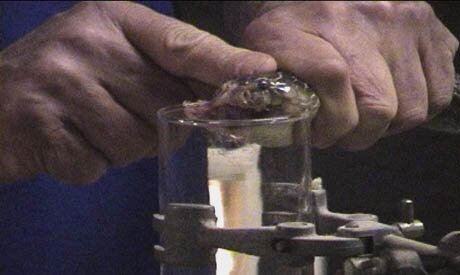
This installation presents a dramatic film of the late Jack Corney, an extraordinary world snake expert and owner of Sandown Zoo, a World Health Centre for Venom Collection on the Isle of Wight. The film follows his skill and actions in extracting venom from a deadly Cobra. Jack Corney worked closely with David Theakston, of the Liverpool School of Tropical Medicine, to supply venom to the World Health Organisation for the production of anti-venom. As a result of his close encounters with some of the world's most dangerous snakes, Corney ended up in intensive care on three occasions. Once, after being bitten by a rattlesnake, he was pronounced clinically dead - at the time he had an "out-of-body experience", and reported being fully aware of the doctors' attempts to revive him.

Shamanism
The video works on a psychological and mythic level to convey an intimate shamanic understanding and intuitive handling of the snake on a biological and biomolecular level. During the close process of filming the Cobra escapes, creating a dangerous situation. Since filming it was discovered that over time he had become immune to the powerful neurotoxins in Cobra venom.

View the VENOMOUS Gallery

Publication and Presentation

Experiments in the Moving Image, London.
DNET, Lux centre, London


August 27, 2006

Parable

Video and sound installation developed for The Contemporary Arts Centre, Vilnius, Lithuania as part of Twilight. Presented at Onufri, The National Gallery of Art, Tirana, Albania 2003

triparable.jpg

triparable2.jpg

Video stills from the Parable of Raudonavaris

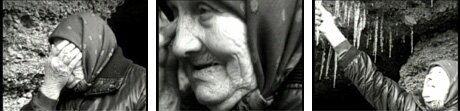
Installation featuring Palina Panamarcuk, originally from Belarus, filmed in the caves and forest in Raudondvaris near Vilnius.

The Feminine Principle
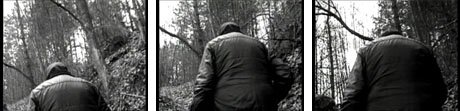
Lithuania was one of the last countries in Europe to convert to Christianity, and pagan beliefs and nature religion is strongly evident. The feminine principle is characterized by the close relation with water, earth and the moon. In this work, body, soul, mind and land overlap in a mythic portrayal of Palina Panamarcuk as the 'anima telluris', carrying out a ritualistic journey to a hidden and sacred place in the forest. The work was made in response to the history of the Soviet occupation in Lithuania and the history of the forests around Vilnius. Forests were the sites of killings and concealments. They were also the first places to be associated with Pagan beliefs in Lithuania. Palina Panamarcuk had been a nurse in the Russian army. She maintains a healing spring within an ancient cave in the forest of Raudondvaris and uses the water for healing.


View the PARABLE Gallery


Twilight UK was curated by Tracey Warr, author of the Artist's Body

Twilight is an international project of contemporary art which flourishes and functions in the dark: an exhibition of art created on the basis of new technologies which require darkened premises. complex computing, sound and image devices and an uninterupted supply of energy. It is a reflection of the political, social and cultural twilight. An attempt to perceive another side of culture, which is mostly unseen or ignored in daylight. The state of uncertainty and doubt.

Twilight Catalogue

The work was made possible by consultations with Vygintas Vaitkevicius, a photographer and archivist of sacred sites and Dr. Nijole Laurinkiene, from the Institute of Lithuanian Literature and Folklore.

Publications and Presentations

Twilight Catalogue.

Onufri, National Gallery Tirana, Albania


August 26, 2006

The Water Projects

Various site specific projects made for The Incident, in the city of Fribourg, Switzerland as part of the Belluard- Bollwerk International festival.

watermapxxxx.jpg

Dowsing of remotely viewed map of Fribourg showing underground water pools, lakes and springs

Water Vortex
The water projects consisted of installation and performance work made in response to the water courses and medieval fountains of the city. All the projects were based on site specific research and the anomalous properties of water. The themes were inspired by the scientific work on vortex currents in water carried out by the engineer Viktor Schauberger

water100embed.jpg

Installation detail showing collected water sample and light reflections

Everything emerged from the water. Water therefore is the raw material of every culture and the basis of every bodily and spiritual development

Viktor Schauberger

waterslide2mid.jpg

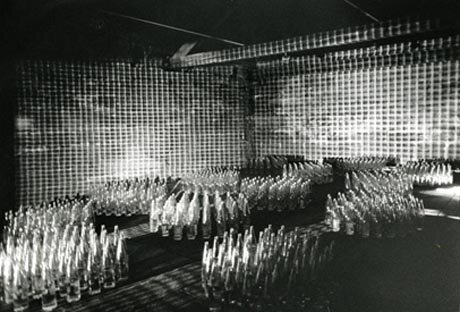
Installation view showing bottled local water samples and video projections


Without the perception of anomalies there would be no science and no art, there would be no religion either.

Jacques Vallee
speaking at the Incident

watertrioxxx%20copy.jpg

Visible and invisible water courses in Fribourg

The projects engaged with research into the possible electromagnetic, molecular memory of water as proposed in a hypothesis by the bio-molecular chemist Jacques Beneveniste. Beneveniste carried out experiments akin to homeopathic methods to suggest that water had a recordable molecular memory. My interest was to extend these biomolecular methods and metaphors into artworks. The basis of this work was to re-imagine Fribourg as a fluid databank using the analogy of the telephone system and linking mind, body, earth.

Water Consciousness Databank
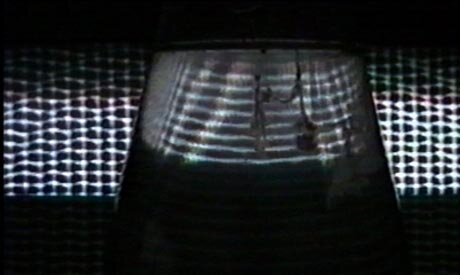
Installation work was presented in the upper gallery of the Bollwerk fortress. This consisted of a dual screen video projection and sound, a floor installation of several hundred bottles of water, a small diorama and graphic artworks. The installation represented a vast fluidic data bank using water samples from Fribourg. The installation was conceived as a metaphorical computer in the form of hundreds of glass bottles filled with water, placed into patterns. A projected video image composed by mathematical algorithm generated a moving image of a wave train ripple of water played a pattern of light across the glass. The simple wire frame image refracted through water and filled the darkened space with ambient patterns and waves of light. These kinetic currents were reinforced by recordings of heart beat, rushing water and white noise.

waterslidexmid.jpg

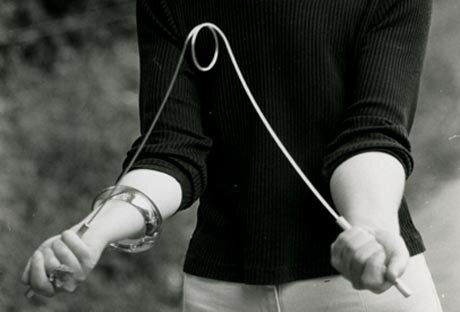
Vortex water divining tool used in Fribourg

Remote Viewing of Water Vortex Energy Map
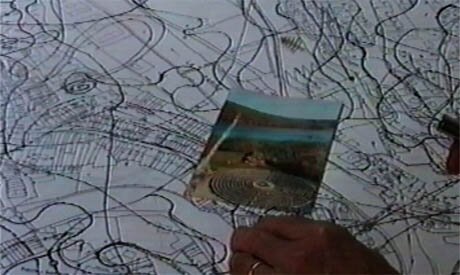
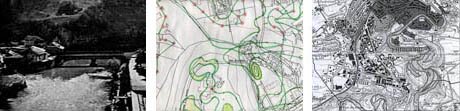
Remote viewing and the mapping of the invisible through dowsing. In map dowsing for water the dowser can use a series of passes over the map to plot and locate underground springs and streams. The project employed the skills of a remote viewer and water diviner, Elisabeth Sulivan from Wales to create maps of unseen forces and water course energy systems in the city of Fribourg and to develop a physical map. I collected water samples from the fountains and the Sarine River. This water was analyzed in various ways. Elisabeth Sulivan, a member of the British Dowsing Association agreed to work with me to divine the routes and quality of underground springs and water systems in Fribourg using maps. She did this remotely from Benton Castle, her home in Wales. After several months a map arrived of the spiraling energy lines of water which were drawn and superimposed over the city plan. I took this unique map to Fribourg and recorded the re-reading and testing of the marked spiralling lines by two local water diviners using different techniques.

bestdowser.jpg

triodosing.jpg

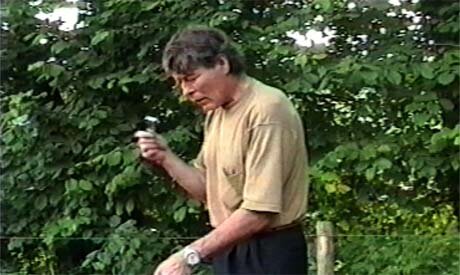
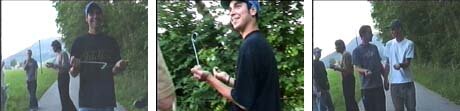
Water divining workshop in Fribourg

Water Divining Workshop
The map provided the basis of a public workshop on the theme of intuitive modelling. With the help of the Belluard Festival organisers I set up a small workshop with local people and a well known local dowser taught them how to dowse. Dowsing has been used as a means of divination and for seeking out the invisible and unknown for many thousands of years. It is based on the analysis of intuitive knowledge. By the use of a pendulum one learns to take note of certain reflex. There is an established relationship between the location of churches and underground water. In the general index of Jung’s collective works there are many symbolic meanings attached to water. With the mythological, astrological and psychological aspects of water a link is made between living water, redemption and the wholeness which is the aim of all psychological work. Jung established the existence of the collective unconscious which he described as the vast ocean in which we find the archetypes. The built-in shapes and patterns which come to life when a conscious experience lends them power.

fountatyiemb.jpg

jeremy%20narbyembed.jpg

The Tinguley fountain recordings with Jeremy Narby

The Tinguley Fountain Recordings
People from Fribourg were invited to write anonymous poems in dedication to the Sarine river and figurative, allegorical fountains. These dedications written in German, French and English were chanted aloud by Jeremy Narby as part of a public performance to the noise of the crazy Tinguley fountain (Tinguley was born in Fribourg) a portable radio on the wall of the fountain was also playing white noise that sounded like water. The poems were repeatably read in several languages into a portable tape recorder against the crazy rhythms of the spluttering fountain. The multi- recorded tape was then played back loudly as a public sound performance.

View the WATER PROJECTS Gallery


At the Belluard, Rogers created an installation in a gloomy corner loft high inside the fortress. On the creaky wooden floor of the loft stand elaborate patterns of glass bottles each filled with water. Candles flicker on the bottle glass, making the water shine and sparkle. Video monitors around the edges of the room reflect the scene and put it into fluid motion. The theme of Roger's The Memory of Water is the elemental energy pattern inherent in water. The power of the water element that usually goes unnoticed now hovers ghost like through the room. The phenomena can be literally true yet keeps its essential mystery.

Kathleen Roger's The Memory of Water fuses thick darkness with an array of light patterns - computerised and elemental - to coax the viewer into peripheral vision. She also uses sound patterns to gradually widen the edges of experience. The end effect on the viewer resembles James Turrell's luminosity. Both affect the feeling of the space/time dimension. Peripheral awareness renders the present spacious and non-temporal. Relaxing into our physical centre and letting attention sink into the gut, the eyes soften and the attention spreads throughout the entire field of view. The awareness lives in open space as opposed to the brain's linear time sequence. A wide-angle view slows down the frantic race of the logical chains of thought. We find ourselves visited by those cosmologically primal elements in which we live: water and light. They manifest themselves under artfully prepared conditions.

Virtual design stands at the crossroads of interactivity. Two models of world-building beckon: the tunnel and the spiral. The tunnel sucks us further into technology. The tunnel molds human perception to push forward, to ignore peripheral awareness, to fixate. The spiral, on the contrary, rotates us in virtual worlds that return us to ourselves, that deepen the wide-angle awareness of ourselves as primary bodies. The tunnel teaches us to maintain first-person perspective while the spiral attunes us to others from whom we learn about ourselves. The tunnel feeds us more information. The spiral aspires to wisdom.

Michael Heim, Philosopher
Virtual Realism

Publications and Presentations

Virtual Realism by Michael Heim

The Incident, Symposium, Fribourg, Switzerland as part of the Belluard- Bollwerk International festival.

The Incident
For several years I worked alongside curator Rob la Frenais contributing to both the intellectual and artistic concept of the Incident in Switzerland and London. The Incident exhibition and symposia themes were concerned with art, technology and phenomena. In Fribourg, the event was composed of exhibitions by major visual artists, performances by theatre companies and music groups and a two week series of talks and debates and a three day symposium of art and phenomena. The conference was addressed by figures such as Jacques Vallee, the noted astronomer and computer scientist, James Turrell, the visual artist, HR Giger, the film designer, Kristine Stiles, the art historian, Terence McKenna and Jeremy Narby. Artists included; Linda Montano, Ulrike Rosenbach.

The Incident, London I.S.E.A. archive
The Incident, Switzerland Leonardo almanac archive


August 25, 2006

Viperscience

Interactive triggered sound and video installation concerned with physiological consciousness and imagistic aspects of the snake as encoded knowledge for the Incident at the Institute of Contemporary Arts, London based on the work of the late Jose Diaz Bolio.an anthropologist concerned with the world view and science of earlier Mayan cultures in Mexico.

vipetritt.jpg

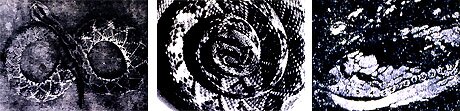
Photos from The Ruins of Uxmal, Jose Diaz Bolio

Viperscience and the Feathered Serpent
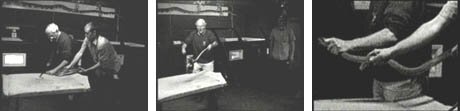
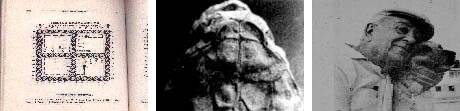
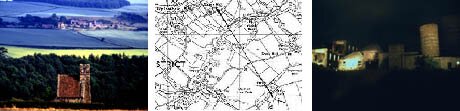
Installation based on the detailed work of the unorthodox anthropologist Jose Diaz Bolio from Yucatan, Mexico, an expert on Mayan culture and author of The Feathered Serpent Axis of Cultures. According to Bolio all representations of the feathered serpent derive from a particular indigenous rattlesnake. His work sets out to prove that the snake has a euclidian projection like a bio-abacus in its skin pattern. He proposes that this pattern provided the ancient mayans with a biomathematics to calculate time and apply to their architectural and ritual systems. The author Doris Lessing uses science fiction and ancient mythologies to grapple with theoretical science and in a similar way, Bolio uses hundreds of photographs and pamphlets to set out to prove his thesis with visual evidence. The narrative of his work stretches over five decades. These documents inspired me to visit the Mayan ruins in Uxmal, Yucatan, a pyramid complex and tangible serpent universe described in his books and to meet and collaborate with him on a technological extension of his work using his title Viperscience.
Rattlesnake Cage
Installation in upper gallery, using ultra sonic triggered rattlesnake recordings as live mix with deep bass audio and random signal noise. High contrast black and white video projection, presenting optical illusion of side winder snake appearing to make a three dimensional spiral path as it moves along a flat landscape. The imagery and triggered audio patterns operated on the senses to re-create a physiological and mythological counterpart to the Mayan snake temples at Uxmal. In the context of the Incident, the unpredictability of the snake with its archetypal and universal symbolism referenced the artificial control systems in robotics that mimic some of the primordial sensory locomotion of the snake. These machine augmented serpents are consistent with Jung's definition of an archetype that persists through technological reinvention and time. In the case of the viperscience the unconscious destructive and creative potential in human beings, described by Jung also invoked the iconic image of the spiraling vortex of DNA driven biotechnology.
triox.jpg

triov1%20copy.jpg

trio2.jpg

trio3.jpg

trioz.jpg

Photos from The Feathered Serpent Axis of Cultures, Jose Diaz Bolio

View the Viperscience Gallery

A nest of Mayan rattlesnakes hiss and writhe in greeting to people entering Kathleen Rogers' installation, Viperscience. Human movements in the room are detected by ultrasonic beams, unleashing a battery of fizzling rattler recordings and animating a twisting and flickery video serpent. The Mayans used the plumed serpent as a sort of mystic abacus, counting the scales to compute their sacred calendar.

Judith Palmer, The Independent

Lost Knowledge
In the context of the work a panel was put together called Lost Knowledge with Robert Bauval, an expert in Egyptian archeo-astronomy looking at the origins and function of the pyramids and the sphinx, David Peat, working on dialogues between western scientists and Native American Elders and Beata Bishop, a Jungian psychotherapist, working on European Shamanism and healing.

This paper reviews the first "Consciousness Reframed" conference. A number of artists' works in media such as virtual reality and interactive installations are discussed, and various issues relating to "technoetic" artworks are raised. These issues include questions such as the potentially dehumanizing nature of technology, the transcendent states claimed for cyberspace, the nature of immersion, and aspects of the problem of consciousness. The author offers some suggestions regarding how technoetic art might tackle such issues

Beyond dreaming one comes to the trance states of the shaman. Kathleen Rogers in her paper "Viperscience" explores Mayan shamanism in the mythology of the snake, She "draws on the work of the unorthodox anthropologist Jose Diaz Bolio from Yucatan, Mexico...author of The Feathered Serpent - Axis of Cultures" to explore the role of the rattlesnake in Mayan art and religion. Bolio has proposed "that the plumed serpent in the image of the rattlesnake embodied the essential physical resonance, energisation states and vortex mechanics to become a living psychic software." That is that the priests of the Mayan culture use the "harmonic geometry of the snake skin as mask for scrying" and similar shamanic activities. Rogers' intention "is to re-activate this complex model of Mayan consciousness" as a kind of cognitive archeology of the snake in its, perhaps universal, representation of spiritual energy as well as the cyclical notion of time held by the Maya.

Stephen Jones
Project review in a philosophy of Virtual Reality and issues implicit in "Consciousness Reframed" published in Leonardo Journal.

Publications and Presentations

The Incident, Lost Knowledge, ICA london.
Further details

Towards a Science of Consciousness III, University of Arizona, USA

American Association of Anthropology, SAC, Berkeley University, USA

CAII, Consciousness Reframed I, University of Wales

Digital Dreams 4, Accross two Cultures, Millenial Fever or Emergent Culture? Newcastle.
Distributed by the British Film Institute.

European Snake Society - Litteratura Serpentium
Journal Article in issue concerned with the biological, cultural and symbolic aspects of serpents. Viperscience. Ode to the Unorthodox Anthropologist Jose Diaz Bolio. ISSN 0926-3586


August 24, 2006

Psi Net

triple1.jpg

triple3.jpg

triple2.jpg

triple5.jpg

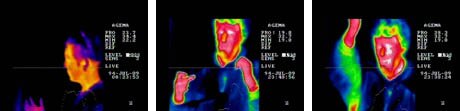
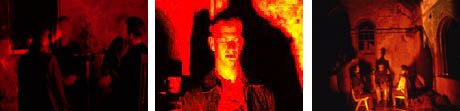
Photos, video stills, background research and thermographic images from Psi Net

Extended Reach, Telephony and Telematics

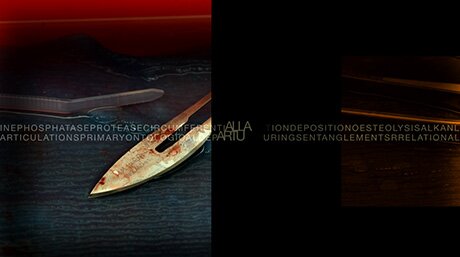
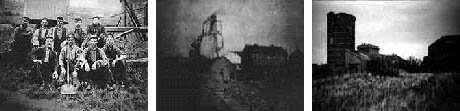
Psi net was a of series of three hour long live, on-site, remote viewing and mediumship experiments made over three nights at a ruined ironstone mine in East Cleveland applying highly sensitive thermographic optical scanning, bio-feed back heart recording and voice recordings transmitted live locally via a microwave link. The work was made in response to the landscape and history of the post industrial mining landscape of the area as part of Earthwire and was developed over a several month period by gathering sources on the history of the local industrial, and ironstone mining communities from collections and museums.

Psi net featured spiritualist mediums Audrey, Darren, Sharon and Margaret from Norton spiritualist church. As spiritualists they believe in the continuation of life after death and that this can be proved through mediumship. I arranged that them to take part in mediumship experiments and seances at Skelton Park ironstone mine, an arrangement of ruined buildings preserved over a hundred years in the landscape above the old ironstone mine workings.

It was agreed to make an open seance circle above the exposed drift mine workings over three nights after dark for one hour at which times we would meditate and respond to the presence of spirits. The maps of the underground mining tunnels which were now disintegrated through subsidence still extended miles in all directions like roots or mutilated arteries. The warren of flooded pit shafts were routes that at one time had been filled with miners bound to working underground in darkness.

This psychic and subjective accounting and relating to the invisible world brought with it a rich narrative account of the place and its history. These experiments and the unfolding stories were the improvised means to create a living virtual museum.

The work was designed as a public performance to be displayed on two sites simultaneously. The sites were one mile apart and linked using micro wave broadcasting system. Powerful lights and generators were installed to illuminate a church in the foreground and the ruined mine along a sight line. Tents were made from found materials in a field beyond the church and live video and sound broadcast was received locally on a monitors and several speakers within these make-shift tents. Both the church and mine were clearly visible in their night illumination by spectators in the field
The thermographic optical scanning, bio-feed back heart recording and voice recordings were transmitted via microwave to spectators occupying the field and the tents.

The results were recorded and kept

The curatorial themes of the EarthWire proposed radical uses of art and technology in a rural context and events took place at outdoor sites in East Cleveland around the villages of Loftus, Upleatham, Boulby, Lingdale and Kilton Thorpe. The project was curated by Tracey Warr and Rob la Frenais.

View the PSI NET Gallery

Publications and Presentations

Information Arts, Intersections of Art, Science and Technology by Stephen Wilson 2002

Information Arts Link

Virtual Realism by Michael Heim

I.S.E.A., Spacescapes/The Body, Helsinki, Finland

COIL Journal of Experimental Media, Vol.1

Exposure Journal, Power and Control: Imagin(in)g Technology, The Society of Photographic Education, vol 30

Mute Magazine, Earthwire, Taking the Alien Exam by Rob la Frenais

The End of Reality, Art and Technology Symposium, Bratislava


January 29, 2006

Sleepless Dreaming

A series of Interactive VR works for use with headset and data glove and the multi screen installation, The Still Room, were shown at The State of the Image as part of Eldorado and the cultural capital of Europe, Koninklijk Palais, Antwerp, Belgium.

triovr.jpg

triovr1.jpg

Video stills from Sleepless Dreaming in the Cybernetic Cabinet

The Electronic Void
Sleepless Dreaming composed of computer model houses and interiors that a participant could navigate through to experience the gravitational paradox and the heart of VR . In this work a participant was in effect in two spaces simultaneously. In the real world of the gallery, and moving along a recurrent corridor of rooms navigating through doorways, along walls and into a void.

Haunted House
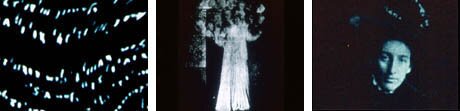
A participant was represented by an avatar in the form of basic three dimensional cursor and navigated using a data glove and hand gestures. The interior spaces were rendered with images of early spirit photography collections. The reading of the infinite space suggested by VR and these reversioned images provided a nostalgic vision of the technological VR apparatus.

Marionettes
Spirit photographs date back to the very beginning of photographic history and continue to be an important part of spiritualist practise. Ghostly images resembling dead family members appearing alongside a sitter became known as extras and the photographers claimed to be psychics.In a VR space, the marionettes we encounter might be automatic projections from our own consciousness, or they might have their centers elsewhere. They might be the dead dreaming of the dead or the dead dreaming of the living.

vrcuslide.jpg

Video still from Sleepless Dreaming in the Cybernetic Cabinet

Parapsychology
The multi-sensory model of VR at the time suggested an infinite number of possibilites for transducing the senses and body. The project research led to a participation in laboratory experiments within the Department of Parapsychology at Edinburgh University where I explored anomalous phenomena associated with ESP. This research was acheived within an electronically controlled telepathy experiment with the late Koestler Professor Robert Morris under the direction of parapsychology researcher, Kathy Dalton who was exploring out-of-body experiences, dissociation, absorption, and alterations of consciousness with a creative population in the Ganzfeld . The perceptual psychology department, were using immersive VR in experimental work. The themes of intuitive modelling and ESP are developed in later projects.

View the SLEEPLESS DREAMING Gallery

Publications and Presentations

The State of the Image, Antwerp, as part of the cultural capital of Europe
Eldorado, Koninklijk Paleis, Antwerp, Belgium.

Variant Magazine, Virtual Real Estate.

Fotofeis International, Virtual Reality, Scotland.

Seduced and Abandoned in the Virtual World, The Body as Metaphor, Institute of Contemporary Art, London. Video distribution by ICA publications.

A.S.T.A.R.T.I. , Mutations de l'image, Deuxièmes Rencontres Internationales Art cinéma, Paris


The Rites of Reclamation

Single screen video

triorec%20copy%20copy.jpg

Video stills from the Rites of Reclamation

Interior Space and Memory
Single screen video in distribution through LUX. This work is a reversioning of virtual space experimental narrative work and psi net with sound composition by Steve Parr. Virtual camera navigation was used to create narrative inside a computer model of a ghostly interior.

Publications and Presentations

Prix Ars Electronica, Linz.

Institute of Contemporary Arts, London.

Champs Libre, Montreal.

Chronologie, Poland.

Manchester Cornerhouse, Video Festival, Best of British Category

Experiments in the Moving Image, London

The British Film and Video Directory

SeaFair Festival


January 28, 2006

Bioapparatus

Technology and Body
VR produced at the Banff Centre for the Arts Canada during a residency conceived by Catherine Richards and Nell Tenhaff who introduced the themes of the technological apparatus, the technological body, and the new biology. This was one of the first public arts events to examine virtual realities and the interfaces between technology and the human body

triovrb.jpg

triobanf.jpg

Video stills from Bioapparatus

Residency
The 10 week residency involved 21 artists, writers, philosophers and scientists and centered around the notion of the bioapparatus, a term used to cover a wide range of issues concerning the technologised body and the cultural and political manifestations of virtual reality.

Gravity
A number of works were developed from theories of perceptual psychologist Rudolph Arnheim. In his book, The Power of the Center: A Study of Composition in the Visual Arts, he gives importance to the whole sensorium of the body, including gravity on the reading of an artwork. I applied his observations of gravity and visual perception to simple Euclidian points, lines and planes projected into the black void of the VR world. In VR, the sensations of locomotion and position are paradoxes that require careful observation and experiment. I made a number of exercises to capture a moment of consciousness between stillness and movement. Creating primitive wire frame models and rendering them with images from a previous artwork, the Still Room in order to experience them in this new context. For instance in VR, falling through the surface of images produces a cut, similar to an film edit. Hopscotch, provided a metaphor for the nature of VR gravity because of the impulse it provided to jump or fall through the virtual model and the navigational path it provided.

Given today's 'hyper-real' environment of image saturation on the one hand, leaving art and artists in what has been called a crisis of representation, and the development of highly sophisticated representational technologies on the other hand, it has become crucial to open up and expand the discourse on art and new technologies. The territory has been interpreted most often through the lens of technology itself, disconnected from the broad range of art practises and cultural discourses circulating today. The artists, composers and writers in the residency have been brought together principally to advance their own art production. In addition, we have built a parallel objective into the residency - namely to map significant shifts in philosophical and representational issues that are coextensive with technological change

Catherine Richards, Nell Tenhaff
The Bioapparatus Catalogue

Publication and Presentation

Human, Machine and Animal Cognition, Aix en Provence

Assemblage, Edinburgh Film Festival

The French Ministry of Culture, Paris - Delegation of the Arts Plastiques - Digital Salon
Participant with Anne Marie Duquet and artist Louis Bec to introduce VR themes and the Bioapparatus. The aim of the panel was to present future technological research and invent new initiatives to integrate the methodologies of science and art into educational culture.


January 27, 2006

Alkhemia

Experimental VR applied as multiple screen video installation

trio%20alkhemia.jpg

Video stills from Alkhemia

Surface Light and Noise
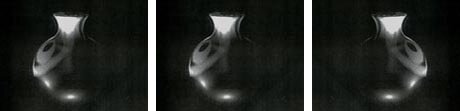
A series of computer generated, primitive black vases slowly turning against black backgrounds in clockwise and counter-clockwise directions are partially visible through virtual reflections on their surface. The work explores the theme of the electronic void as an echo using granular techniques to provide a four dimensional acoustic landscape. The research was carried out at Banff Centre for the Arts. The models were produced at the virtual studio London and an immersive model was designed to experiment with acoustic and visual paradoxes.


January 22, 2006

The Art of Losing Memory

Single screen video

tillosss.jpg

Video stills from the Art of Losing Memory

The Poetics and Patterns of Memory
A montage of image and text on screen make connections between
the human being and merciless aspects of technology. The work has a sound composition by Stephen Warbeck

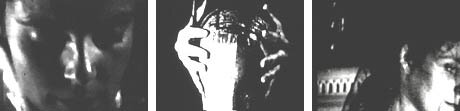
Kathleen Rogers works in "The Art of Losing Memory" with the analogy computer memory / personal memory. In black / white images Rogers shows a woman doing handwork, a seamstress engrossed in her work and following a certain pattern until it finally becomes a textile product of the memory. The images are atmospheric, the movements of the performer are graceful: everything is somewhat poetic, undecided. In contrast to this, the computer asks simple questions, gives possibilities for decision: "Your choice. Yes / No." Rogers distrusts the simplicity of the binary 1 / 0 system. The coded matrix is a "veil of delusion". The computer has no memory. Its capacity is limited to the duplication of data, it lacks the complexity of memory experience, "The Computer Has No Memory. I See My Eyes Open".

Gerald Harringer
Ars Electronica


Selected Presentations

Ars Electronica, Linz
A.S.T.A.R.T.I. , Mutations de l'image, Deuxièmes Rencontres Internationales Art cinéma, Paris
ICA, London
European Media Arts Festival, Osnabruck
The British Film and Video Directory
Femme Totalle, Dortmund


January 21, 2006

The Still Room

Multiple screen video wall and sound installation developed for Exeter Memorial Museum and screened The State of the Image as part of Eldorado for the cultural capital of Europe festival, Koninklijk Paleis, Antwerp, Belgium.

tristillrooom.jpg

Video stills from the Still Room

The Art and History of Lacemaking
Based on the art and history of lacemaking linking post industrial and pre industrial technology and labour. The work suggests analogies between aesthetically seductive lace pattern and visual computation. The work has a sound composition by Stephen Warbeck.

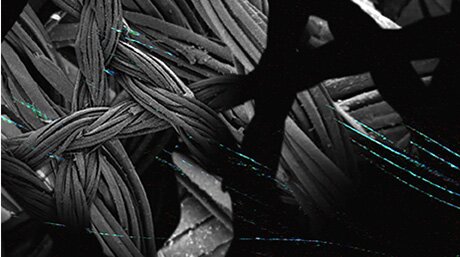
A Jacquard loom in which a succession of punched cards controlled as many as 1200 needles and wove patterns of silk inspired the Babbage engine. The Jacquardtronic lace machine developed in Germany and first introduced into lace manufacture in 1983, brought lace making into the computer age. A pattern manufactured at rapid speed has the insidious effect of erasing from memory and colonising as data, important aspects of labour and industry that dominated the lives of women and children in the 19th century.

Across many screens the knots, loops, twists and turns involved in pattern making are translated into high contrast black and white imagery and rolling text. The soundtrack of a whispering female voice draws the viewer into the momentum and repetition of work.

In the video a female actor is depicted like a set of mechanical forces. Her limbs and joints reduced to senseless action and long scrolls of words recall the lace tells that children vocalised.

View the STILL ROOM Gallery

Publications and Presentations

The State of the Image, Antwerp, as part of the cultural capital of Europe
Eldorado, Koninklijk Paleis, Antwerp, Belgium.

The Walter Phillips Gallery, Banff, Canada

Womens Art Journal (Make) 43 (Nov/Dec 91) and Womens Art Library


January 20, 2006

Conversazione

Multiple screen video installation developed for Central Space Gallery London

tricon.jpg

Video stills from Conversazione

Loss of Freedom
Installation using montage of multi-layered sound, developed around an oral history account of an elderly woman traveller living under the Westway flyover in Hammersmith with a sound design by Ray Beckett. The visual material was filmed at the traveller site and at other events in collaboration with local community organisations these included filmed material from a production of Frankenstein by the Co-sign deaf and hearing theatre company. The work expressed the continual pressure for institutionalisation and conformity at odds with the utopian view of technological networks at the time. In the gallery I erected a barricade of 19th century neo-gothic church pews into a long pile to suggest an atmosphere of institutional hush.

View the CONVERSAZIONE Gallery

'A zig-zag of church pews processes with chaotic angularity down the gallery. A video showing simultaneously on three monitors begins with a white horse, archetypal symbol of the free spirit, rolling in the dust then galloping languorously, its coat gleaming in the sunlight. Seen in slow motion, the image dwells unashamedly on its own beauty. But on the soundtrack the submergence of Faure's Requiem in insistent traffic noise alerts one to the likely disruption of this romantic idyll. The camera pulls back to reveal that the horse, worried by a snapping black dog, is running freely but circling on a patch of concrete beneath the Westway. A woman's voice complains of appalling conditions in sites such as the Westway intersection, remembers when travellers were free to roam, accuses Thatcher of wanting to round up and gas all gypsies and insists they will fight for their lifestyles since 'if they put us in a house they might as well put us in prison'. A subsidary theme to the loss of freedom is the inability to be heard - a performance by deaf and mute theatre company is followed by a drum marathon in aid of the homeless.

Sarah Kent
Time Out


Sources


This Page

This page is an archive of all entries in 'Work'

R & D is the previous category

Find more on the home page or browse through the archives