Recent on-going artworks are based on an EPRSC funded, Pathways to Impact (PiA) residency at the University of Southampton in the School of Medicine on Stem Cells and Regenerative Medicine exploring the use of stem cells in the area of Bone and Joint research. My research engages with contemporary debates in biotechnology and stem cell research and I have developed numerous works through art and science collaboration that contribute to public critical understanding and discussion of these domains. Engendering public engagement with biotechnological, stem cell and regenerative medicine research, my work engages with the impact of these life sciences on human identity, culture and society. I have harnessed elements regenerative medicine space to create a new body of research, developing this most recent artworks on an EPRSC funded, Pathways to Impact (PiA) residency in the School of Medicine on Stem Cells and Regenerative Medicine exploring the use of stem cells in the area of Bone and Joint research.
The PiA (Pathways to Impact) residency was uniquely devised as a visual arts research project. The site-specific research was produced in association with Professor Richard OC Oreffo and the Bone and Joint Research Group at the Centre for Human Development, Stem Cells and Regeneration, Human Development and Health, Faculty of Medicine.
I co-ordinated regular visits to the department, thoroughly familiarizing herself with bone and joint, stem cell regenerative medicine. The research residency enabled close observation and artistic reflection on the science of osteo-specific differentiation, function and signaling pathways in stem cell populations. The aim is that my creative practice can contribute to a public understanding of the regenerative medicine space through art and science collaboration.
The work hints at ways in which transformative biological processes associated with evolutionary symbiosis can be harnessed as metaphors to interpret regenerative medicine. Exploring the different ways people might come to experience regenerative medicine, the work also reflects on how visual arts led research can improve public understanding of stem cell research.
PROCESS
Regenerative phenomena associated with stem cells touch on the deepest aspects of human identity. Stem cell transfer treatments replace non-functioning and dead cells at tissue sites within the body with healthy donor cells. The hope of medicine is that collections of induced pluripotent stem cells might one day come to form a biological resource for regenerative treatments and general medical use.
Kathleen is interested in how stem cell research can offer new generative metaphors for health and healing and how therapies suggest ways to extend the human lifespan and alter ourselves genetically. Her initial research looked at how stem cell utilization might delay and disguise the physical impact of ageing.
“Buckminster Fuller described the occurrence of structure in chemical elements not as things but as ‘patterns of inherently regenerative constellar associations of energy events’. The dynamic metabolism of each of our cells determines its growth or demise and the sustained presence of stem cells within the porosity of both the embryonic and adult brain, suggests holistic connections between periodicity, cell re-newel, cell death and the nature of mind itself.”
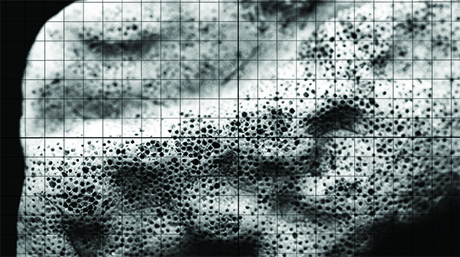
Mesenchymal Stem Cells (MSC), can differentiate differentiate in vitro or in vivo into adipocytes, chondrocytes and osteoblasts the progenitors cells of human cartilage and bone. Kathleen began looking at the shape principles governing the structuring of bone, its emergent mathematics and the geometry of its growth. The structuring of cellular growth is beautifully exemplified in the emergent architecture of bone.
THE WORK
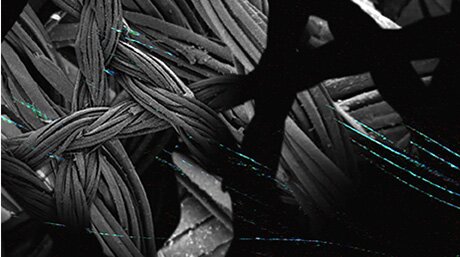
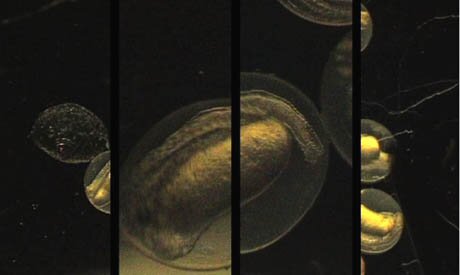
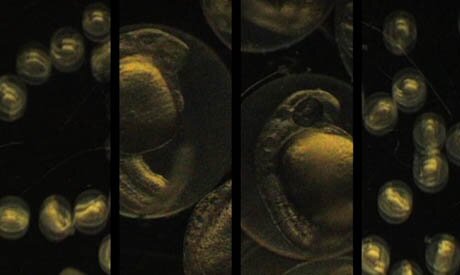
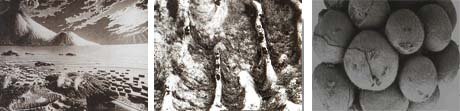
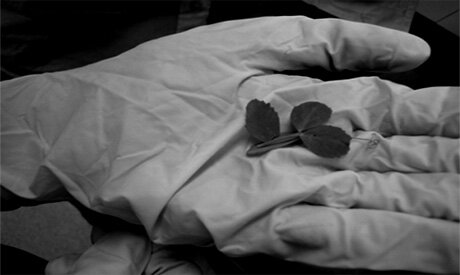
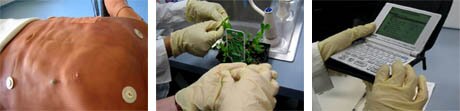
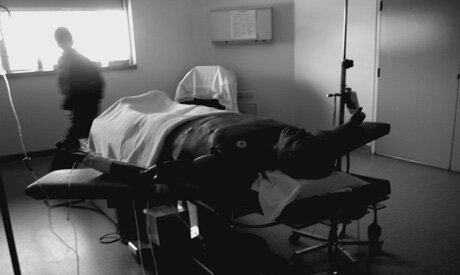
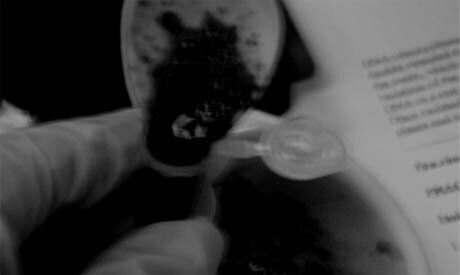
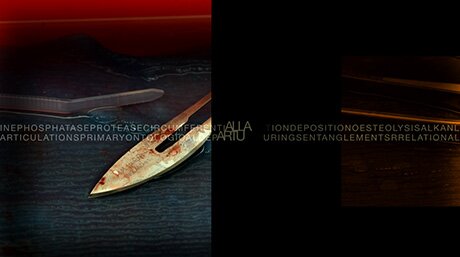
During the residency I was granted access to biological donor materials associated with embryonic, fetal and adult stem cell research. I produced over 2000 photographic studies of human donor derived tissue as the conceptual basis of a multi-screen video installation. Her visual research demonstrates how embodied, sensory encounters with digital media are intrinsic to the visual literacy of medical research. The resulting multi-screen, six-channel video and sound installation, Intra-actions and re-configurings, consists of horizontally aligned screens designed as a panoramic, landscape. Viewed in partial darkness, the work provides an audience with a reflective space and the work offers an emotional engagement with both the clinical and ethical dimensions of stem cell research.
The independently titled episodes dramatize biological procedures: Screen 1 Matter, Screen 2 Vascular, Screen 3 Viscera, Screen 4 Ossify, Screen 5 Primordial, Screen 6 Lacunae.
I applied poetics, moving image and sound to draw every day audiences to the science and art of stem cell research.
“The structural grammar of my work was inspired by the theoretical work of the Philosopher of Science, Karen Barad. Inspired by her concepts I applied graphic and text layering methods to examine how time based, visual and linguistic systems can regulate and dictate interior and exterior perspectives of objects. Dual streams of words composed from descriptive notations, poetry and genetic science are used to suggest parallel images, like labyrinths and mirrors. The work exploits the visual aspects of language and I use imagistic repetitions, tonal variants, scale and magnification to create a contemplative space. Virtual shadows and the sound track, composed of visceral heart pulses are used to invoke the infinite levels of reproduction of living cells in the human body. “
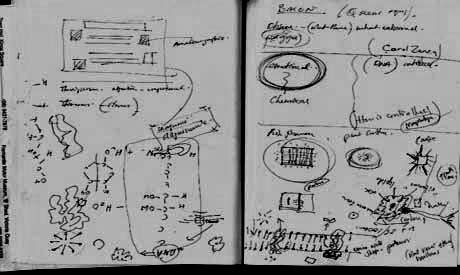
In addition to the installation I produced 15 photographic e-sketchbooks containing hundreds of images drawn from her visual research. These digital sketchbooks presented in landscape format echo the conceptual methods of the moving image installation. Thematic titles are conceptually re-versioned and the form is fluidic: pages may carry a single image or mirror pages found elsewhere; a text frame may directly relate to an adjacent image or may be repeated or carry references to a later image.
Barad, Karen, Meeting the Universe Halfway – Quantum Physics and the Entanglement of Matter and Meaning,
Duke University Press
 email this article
 print-friendly version